Not All Matcha Is the Same
Where the difference begins: the plant
Matcha quality is determined long before it reaches the mill.
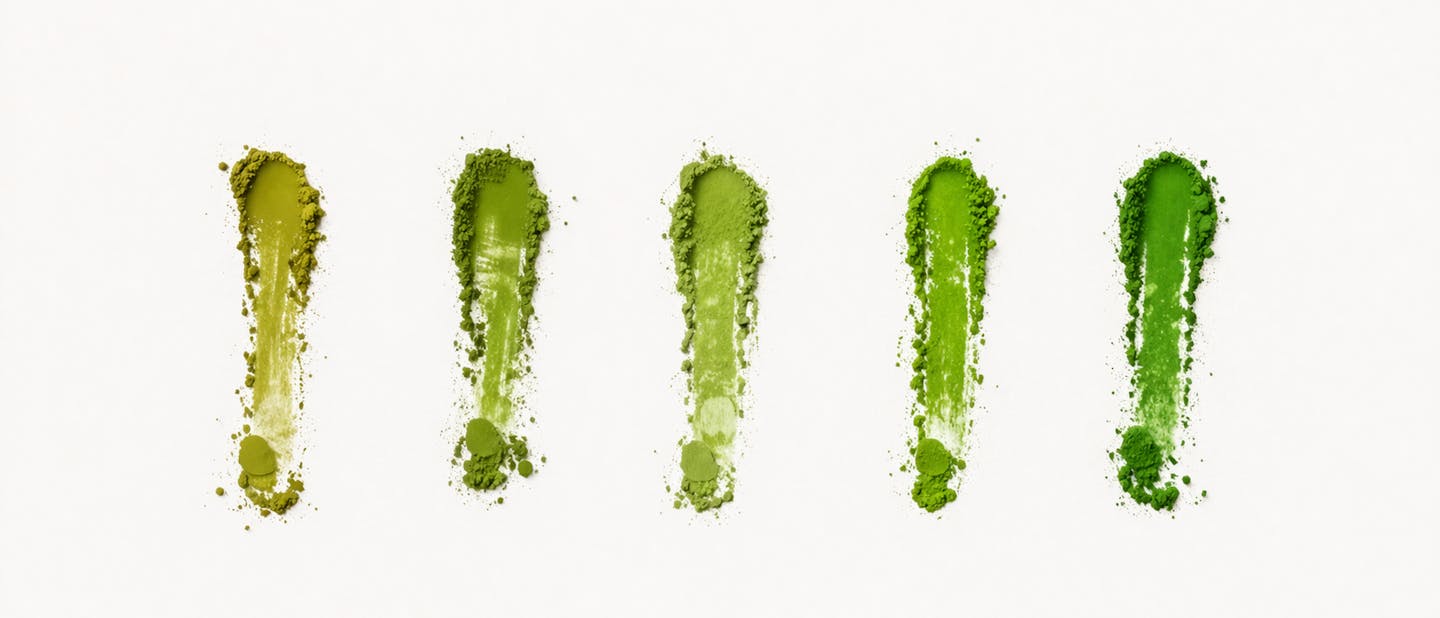
Ceremonial-grade matcha comes from tea leaves that are shaded for 20–30 days before harvest.
During this period, the plant produces more chlorophyll — resulting in a vibrant green color — and more L-theanine, an amino acid responsible for a smooth, non-bitter taste and a calm, sustained sense of alertness.
Only the youngest, top leaves are harvested — and only during the first spring harvest, known as ichibancha.
Each subsequent harvest results in:
less chlorophyll
less L-theanine
a more bitter profile
Cultivar — the specific tea plant variety — also plays a role.
Samidori, Okumidori, Yabukita — each produces a distinct flavor profile.
Similar to wine: all grapes, but not the same result.
Grades explained — what they actually mean
Unlike wine or coffee, matcha does not have a standardized grading system.
Which is why the term “ceremonial grade” alone doesn’t guarantee quality — what matters is what’s behind it.
In practice, matcha falls into three broad categories:
Culinary grade matcha
Used for blending — smoothies, baking, desserts, sweetened lattes.
The flavor is stronger and often more bitter, which works well when combined with other ingredients.
Color tends to be more muted, sometimes slightly yellow-green.
Premium (café) grade matcha
A middle ground.
Good enough to drink, commonly used in cafés for matcha lattes.
Balances cost and quality for everyday use.
Ceremonial grade matcha
The highest quality.
Smooth, naturally slightly sweet, with umami depth and no pronounced bitterness.
It can be enjoyed on its own — and works equally well with milk.
The key difference is that the flavor remains clean and balanced regardless of how it’s prepared.
Origin is not decoration
“Japan” on the label is not just a geographic note.
It reflects tradition, climate, and the expertise of growers.
Uji (Kyoto) has over 800 years of history producing tea specifically for matcha.
Nishio (Aichi), Kagoshima in the south — each region has its own microclimate that shapes the leaf’s profile.
Matcha without a clearly stated origin — or with vague labeling — is a reason to pause.
Not because other origins are inherently bad.
But because without transparency, you don’t know what you’re buying.
Freshness: the factor most people overlook
Matcha is not a stable product.
Once exposed to air and light, it begins to oxidize — losing color, aroma, and part of its chemical profile.
Not over months, but within weeks.
This makes the following essential:
milling or packaging date
proper storage
how quickly it reaches you
Powder that was milled a year ago and sat in storage is not the same as freshly milled matcha from the current season.
There’s also testing.
For the EU market, compliance with standards for pesticides and heavy metals matters.
Matcha that has been independently tested in EU laboratories — with accessible results — is not the same as matcha backed by vague or unverifiable certifications.
Is it worth paying more?
It depends on how you use it.
If you’re using matcha in:
smoothies
baking
lattes with syrups or sweeteners
… higher-grade matcha often won’t make a meaningful difference.
Its subtleties get lost in the mix.
But if you drink matcha on its own — or want a clean, balanced flavor even in a latte — the difference becomes clear.
Lower-quality matcha tends to be bitter, flat, and one-dimensional.
Which often leads to the conclusion: “matcha isn’t for me.”
In many cases, it’s not matcha.
It’s the quality.
How to read a matcha label
Four things to look for:
Origin
Japan, ideally with a specific region (Uji, Nishio, Kagoshima).
Cultivar
Not always listed, but when it is, it signals transparency.
Grade
“Ceremonial grade” should be explicitly stated — terms like “organic” or “premium” don’t indicate quality level.
Freshness
Milling or packaging date.
Conclusion
More expensive matcha isn’t always better.
But the difference between categories is real — and you can taste it.
Before buying, ask yourself:
what are you using it for?
That answer will tell you more than any price per gram ever will.