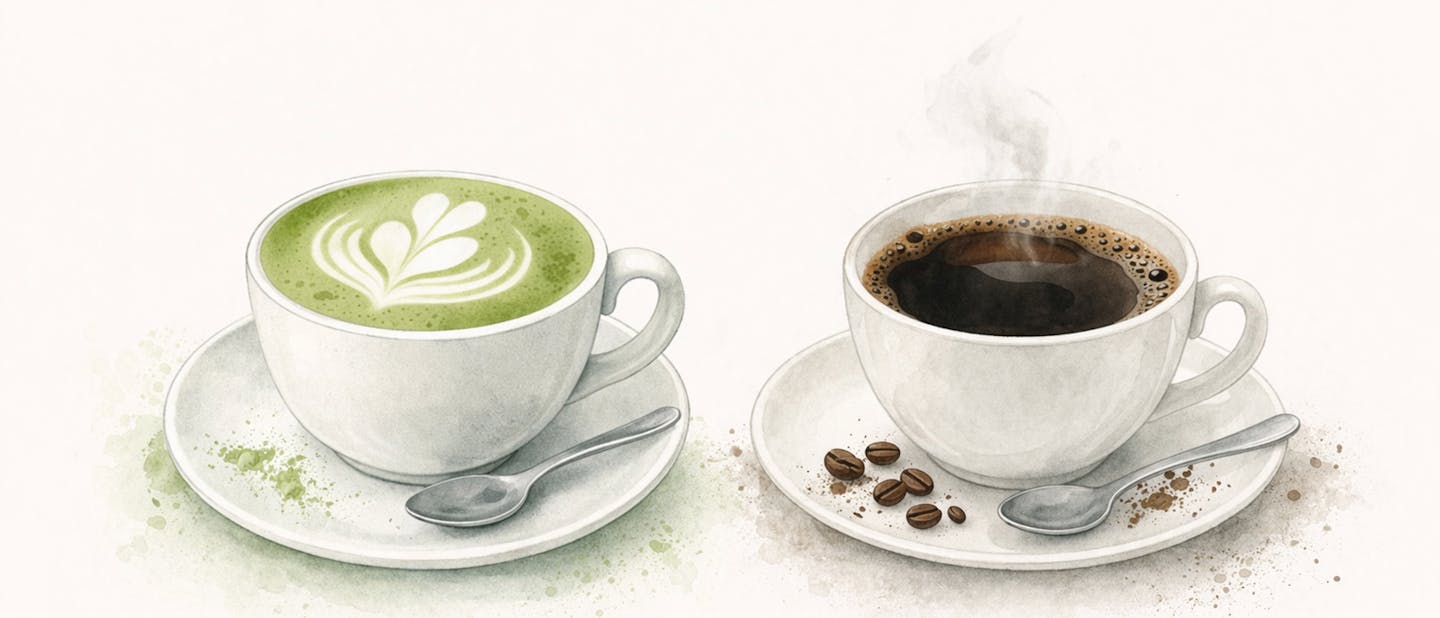
Matcha or Coffee
Why compare them at all
Matcha and coffee are not competitors. They are two drinks with different chemical profiles — and people who drink both regularly feel the difference quickly. The point of comparing them isn't to pick the "better" one, but to understand what sets them apart. If you're thinking about swapping your morning coffee for matcha, or simply adding it to your routine, it's worth knowing how each one affects your energy.
How caffeine in coffee works
Coffee works fast and directly. Caffeine blocks adenosine — a receptor in the brain that signals fatigue. The result is familiar: a sudden lift in alertness. The effect comes quickly, is intense — and often fades just as fast.
Many people know this pattern: focus after the first hour, restlessness or irritability shortly after, an energy dip an hour or two later. This isn't a flaw in coffee. It's its mechanism — and for certain situations, it's exactly what you need.
How matcha works differently
Matcha also contains caffeine — around 70 mg per cup, compared to roughly 100–140 mg in coffee. The key difference isn't the amount. It's the context.
Matcha contains L-theanine — an amino acid found almost exclusively in tea leaves, which influences how the body processes caffeine. It doesn't act as a sedative, but as a regulator. L-theanine promotes alpha waves in the brain — a state of calm alertness, similar to what's experienced during meditation. Combined with caffeine, it slows the release of energy and reduces the sense of restlessness.
The result, described by both users and research (Sohail et al., 2021; Baba et al., 2021): focused attention, less jitteriness, more even energy. It's not magic — it's the fact that you're drinking the whole leaf, not an extract, which means caffeine is absorbed more gradually.
Individual differences are real. Some people barely notice the effect; others feel it immediately.
When coffee, when matcha
The question isn't "which is better", but "what do you need."
Coffee: when you need an immediate boost. Early mornings, long drives, moments when your body needs to respond fast.
Matcha: when you need focus that lasts. Writing, creative work, long meetings, an afternoon block without the crash.
You don't have to choose one forever. But it's worth understanding which one to reach for and when.
What this means in practice
Switching from coffee to matcha is often surprising — not because the energy is weaker, but because it's different. Less dramatic. More even. Some people miss the intensity they're used to. Others find they work with more focus, without the typical afternoon dip.
The difference only becomes clear through experience. If you want a real comparison: try matcha for at least 5–7 days in a row, prepared properly, from a quality ceremonial source. That's when its true effect shows.
Conclusion
Matcha is not a replacement for coffee. It's a different kind of energy — quieter, more stable, less noticeable, but often more useful for long, focused work.
The question isn't which one is better. It's which one better supports the way you want to work.